Nexar APEX: The "Driver's License" for Autonomous Vehicles
The industry’s first real-world credibility test for autonomous vehicles. Move beyond abstract simulation and validate your stack against 10 billion miles of ground-truth human driving data
10 Billion
Miles of historical human driving data
100 Million
Fresh real-world miles captured monthly
99%
Ground Truth road coverage in key cities
Real-World
Benchmarks based on physical intelligence
Simulation is a training tool
Apex is the proving ground
For years, autonomy has relied on digital twins and estimated probabilities. But simulation cannot fully replicate the chaos, surprise, and nuance of the real world. To prove an AV is safer than a human, you need a shared, objective yardstick rooted in reality.
Bridge the "Miles-to-Confidence" Gap: We replace theoretical assumptions with measurable, human-grounded performance standards.
The Truest Source of Truth: Anchored by Nexar’s Real-World Data Engine, capturing the full spectrum of driving behaviors that simulations miss.
Scientific Rigor: Move from theoretical safety to trusted deployment with the only open measurement for machine performance.
The Apex Scorecard
Is your AI ready to drive in the real-world? Compare your autonomous system directly against the human behaviors it aims to replace.
Quantify your stack's reaction speed against average and high-performing human benchmarks in identical scenarios.
Anticipation
Measure predictive risk signals. Did the AV anticipate a hazard as effectively as a safe human driver?
Avoidance
Analyze danger-avoidance behaviors using our BADAS model, trained on millions of near-miss events.
Confidence
Achieve statistical significance without driving billions of physical miles, using our massive historical corpus.
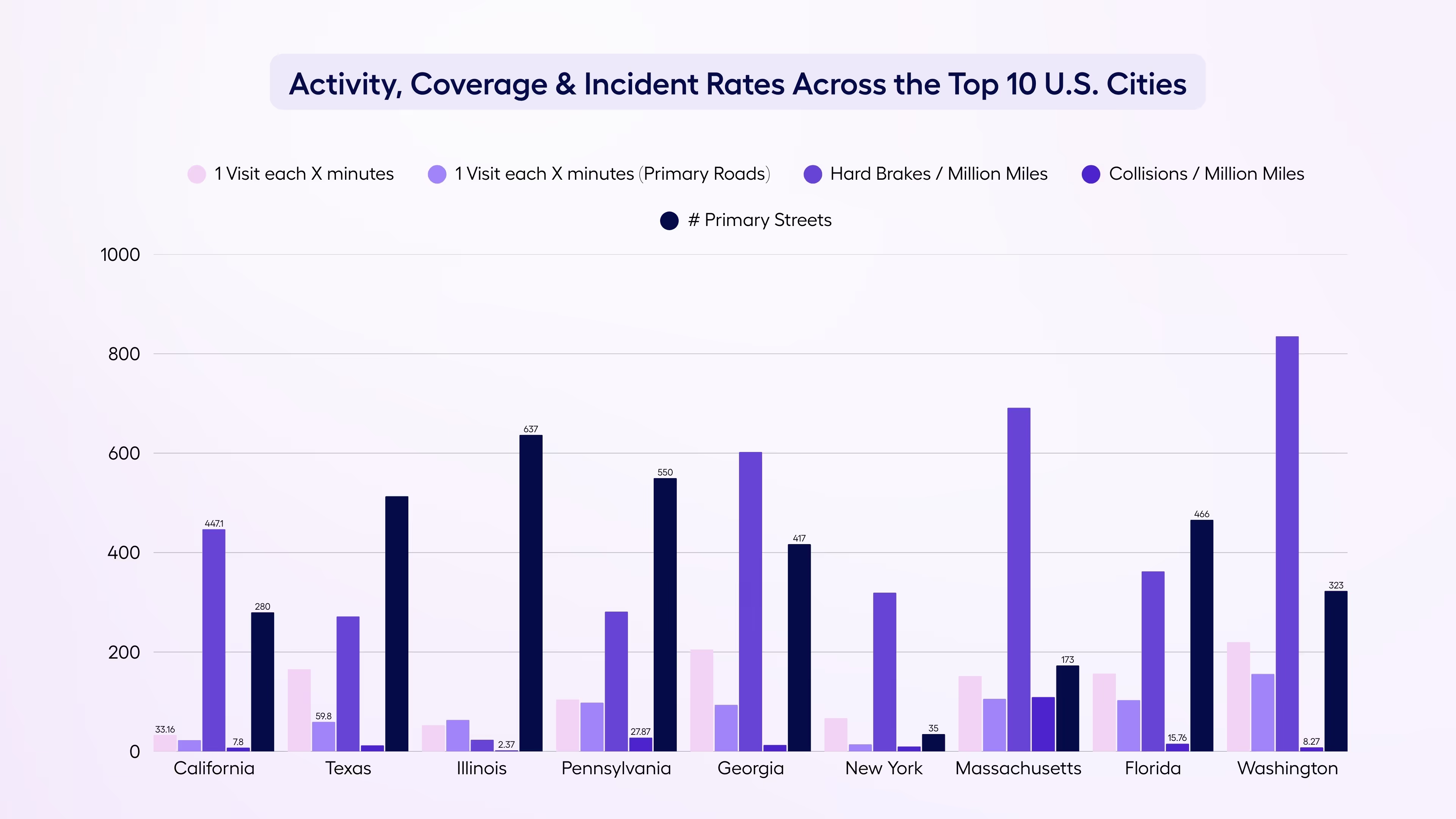
A mile in Phoenix is not a mile in Boston
AV City Readiness Index
Operational complexity varies dramatically by geography. Nexar APEX normalizes these differences using objective indicators derived from our Real-World Data Engine. We provide a clear view of where AV fleets can scale with economic viability and safety.
Collision & Incident Density: Historical crash data per million miles
Volatility Metrics: Construction zones, lane-level friction, and harsh-braking hotspots.
Dynamic Scoring: Scores update with monthly data freshness, reflecting the city as it exists today, not in static maps.